Rocketx Is a Cross-Chain Swap Access and Exchange Overview
Rocketx Is a crypto swap and exchange access point that helps users compare routes, connect a wallet, and move from one digital asset to another across supported networks. A user searching for Rocketx usually wants to know whether the swap page is the right place to trade, what steps are involved, what fees may appear, and which safety checks should happen before approving any transaction.
Rocketx belongs to the broader category of DeFi exchange tools, where the interface is only one part of the experience. The connected wallet, the selected blockchain network, the liquidity sources, the bridge route, and the final token contract all matter. Rocketx can make the process feel more direct, but every swap still requires careful review because crypto transfers are generally irreversible once confirmed on-chain.
For a new user, the most useful way to think about Rocketx is as a workflow: choose an asset, choose a destination asset, compare the quoted result, inspect the route, approve only what is necessary, and verify the final transaction. Rocketx may be used by people who want a simple swap page, but it should still be approached with the same discipline used for any exchange, bridge, or wallet-connected DeFi application.
What is Rocketx?
Rocketx is commonly understood as a swap-focused crypto service that helps users access exchange functionality without manually visiting many individual liquidity venues. Instead of treating a token trade as a single button press, Rocketx sits in the middle of a practical process: it presents a route, estimates output, and asks the user to approve actions from a wallet. That makes Rocketx useful, but it also means the user remains responsible for checking each screen before signing.
Rocketx is not the same thing as a bank account, a custodial brokerage account, or a guaranteed conversion service. In DeFi, a swap is usually executed by smart contracts, liquidity pools, bridge providers, market makers, or aggregator routes. Rocketx may simplify the path a user sees, but it cannot remove market volatility, network congestion, contract risk, or user error. That distinction matters when comparing Rocketx with a centralized exchange or a simple wallet transfer.
The name Rocketx can also create confusion because similar-looking names, company records, unofficial pages, and copycat domains may exist online. Users should verify the exact address, application page, and wallet prompts through official Rocketx sources before connecting funds. A search result, bookmark, message, or advertisement should not be treated as proof of authenticity on its own.
How does Rocketx work for swaps?
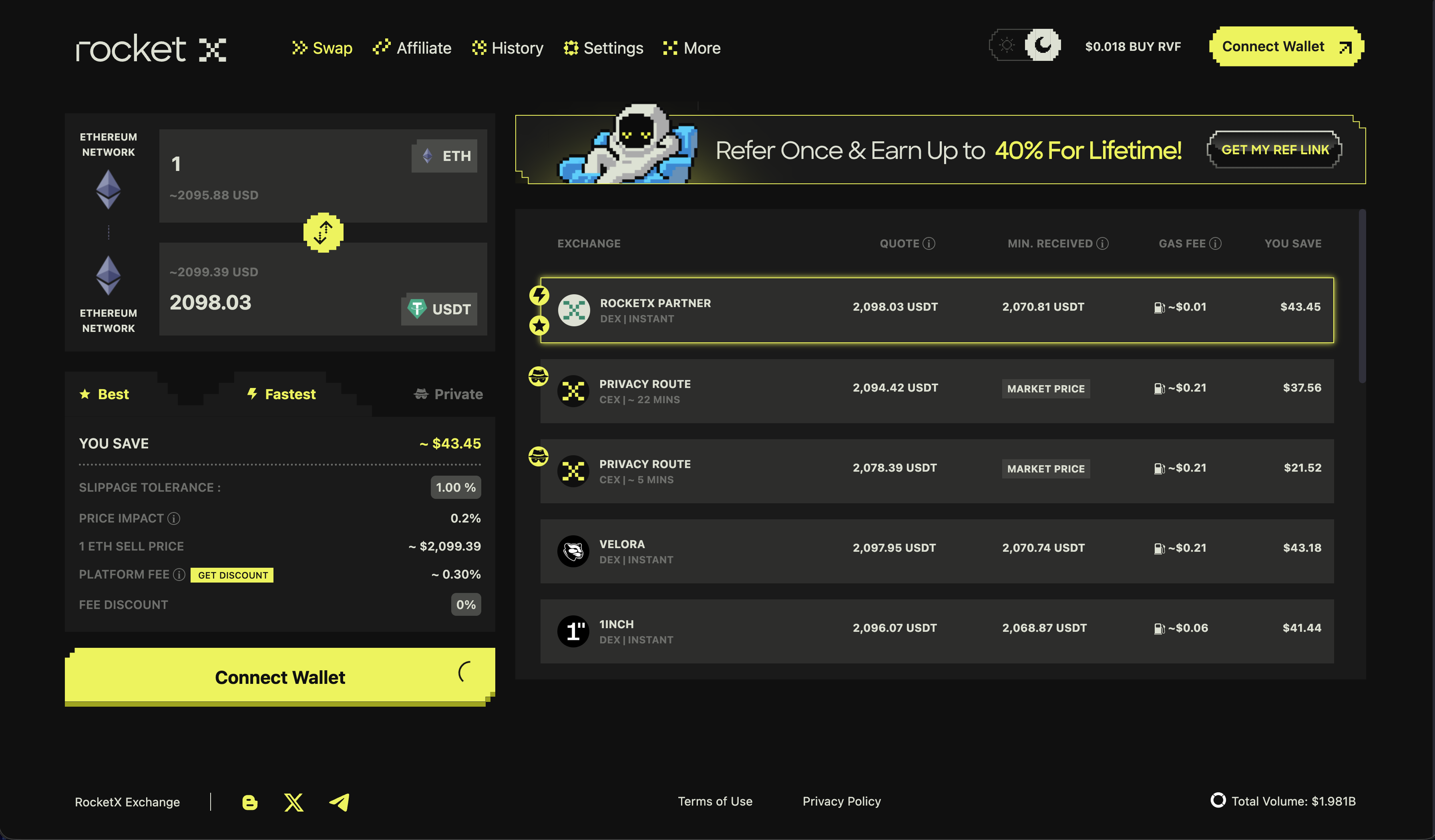
Rocketx works by guiding a user through a token exchange path. In practice, the user selects the asset they want to spend, selects the asset they want to receive, chooses or confirms networks, and reviews a quote. Rocketx may display estimated output, expected fees, slippage tolerance, and the route being used. The connected wallet then becomes the approval tool for permissions and transaction signatures.
The protocol experience can involve more than one blockchain. A straightforward same-chain trade may only require a token approval followed by a swap transaction. A cross-chain trade may involve bridge steps, wrapped assets, destination network confirmation, and extra waiting time. Rocketx can present these as one guided flow, but the user should still understand whether the transaction stays on one network or crosses to another.
Rocketx users should watch for the difference between a quote and a final result. A quote may change because liquidity moves, gas prices rise, blocks fill, or the market price changes before confirmation. Some routes include price impact, bridge fees, liquidity provider fees, gas fees, or service fees. Rocketx may show these costs in different places, so it is worth expanding details before accepting a route.
How do you access the Rocketx swap page?
Rocketx access should start with the verified official source rather than a random message or search ad. The swap page is normally where a user connects a wallet and begins a conversion, but the safest habit is to type or use a trusted bookmark for the official domain. Rocketx should never require a recovery phrase, seed phrase, private key, or full wallet backup to complete an ordinary swap.
Rocketx may ask a user to connect a browser wallet, mobile wallet, or hardware wallet interface, depending on device and network support. A wallet connection only lets a site request information and signatures; it should not require handing over secret recovery words. If any Rocketx-looking page asks for a 12-word or 24-word phrase, that is a critical warning sign and the user should leave the page immediately.
Some readers may want a narrower walkthrough, so an internal can be useful for reviewing the page flow before connecting a wallet. A separate can help compare swap-style access with broader exchange concepts such as routing, settlement, and custody. These guides should support research, not replace official verification.
What is the usual Rocketx swap workflow?
Rocketx has a workflow that should feel familiar to anyone who has used a decentralized exchange aggregator, but cross-chain details can add complexity. The most important habit is to slow down before wallet approval. A swap interface can look simple while the underlying transaction grants permissions or moves assets across networks. Rocketx users should read the wallet prompt and compare it with the page before signing.
- Open Rocketx from a verified source and confirm the browser address.
- Connect the intended wallet and select the correct source network.
- Choose the token to spend, the token to receive, and the destination network.
- Review the estimated output, route, price impact, slippage, and fees.
- Approve only the required token allowance, then confirm the swap transaction.
- Verify the completed transaction in the wallet or relevant block explorer.
Rocketx may require an approval transaction before the actual swap if the token has not been approved for use by the contract. This is normal in many DeFi tools, but approvals should be limited when the wallet supports custom spending caps. Unlimited approvals can be convenient, yet they increase exposure if a contract, interface, or connected account is later compromised.
In practice, many cautious users test unfamiliar routes with a small amount before committing more. Rocketx does not eliminate the need for that habit. A small test can reveal whether the destination network, token contract, bridge timing, and wallet display behave as expected. It can also reduce the impact of selecting the wrong chain or a similarly named token.
What can Rocketx be used for?
Rocketx is most relevant when a user wants to swap digital assets without manually comparing every decentralized exchange or bridge. Rocketx may help with routine token swaps, cross-chain movement, portfolio rebalancing, and access to assets on different networks. It is especially relevant for users who already understand wallet security and want a single place to evaluate a possible route.
Rocketx can also serve as a research step before taking action elsewhere. A user might open Rocketx to compare indicative rates, see whether a route exists, or understand which network has available liquidity. That does not mean the user must execute the swap. For many crypto decisions, viewing a quote is useful only after also checking token contracts, network status, and official project information.
Rocketx should not be treated as a shortcut around due diligence. If a token is new, thinly traded, bridged from another chain, or promoted through aggressive social messages, the risk profile may be high regardless of the swap interface. Rocketx can help with execution, but it cannot confirm that a token is legitimate, fairly priced, liquid, or suitable for a user’s personal situation.
What fees and costs should Rocketx users expect?
Rocketx users should expect several possible costs, and not all of them are controlled by Rocketx. Network gas is paid to validators or miners depending on the blockchain. Liquidity provider fees may apply inside decentralized exchange pools. Bridge fees may appear when assets move between chains. Price impact and slippage can reduce the final amount received even when a route looks functional.
| Cost type | What it means | Why it matters |
|---|---|---|
| Network gas | The blockchain fee for processing approval and swap transactions. | Gas can change quickly during congestion. |
| Liquidity fee | A fee built into the exchange pool or route. | It affects the effective rate of the trade. |
| Bridge fee | A cost for cross-chain settlement or message passing. | It can make smaller transfers inefficient. |
| Slippage | The difference between expected and executed price. | It can increase during volatile markets. |
Rocketx quotes should be reviewed as estimates rather than promises. A route that is economical for a large, liquid pair may be poor for a small token or a congested chain. Rocketx users should also remember that a failed transaction can still consume gas. That is one reason to check balances, token approvals, and network selection before confirming any wallet prompt.
Is Rocketx safe to use?
Rocketx safety depends on several layers: the authenticity of the page, the user’s wallet hygiene, the contracts involved, the route selected, and the assets being exchanged. No DeFi interface can make a transaction risk-free. Rocketx users should verify official sources, keep wallet software updated, avoid unknown links, and never share a private key or recovery phrase with any site or support contact.
Rocketx users should be particularly careful with impersonation. Crypto holders are often targeted through phone calls, direct messages, fake support accounts, malicious ads, and cloned websites. A legitimate support process should not ask for a seed phrase or request remote access to a device. If a Rocketx-branded message creates urgency, claims funds are at risk, or asks for secret information, the safest response is to stop and verify independently.
Wallet prompts deserve close attention. Rocketx may request a connection, a token approval, or a transaction signature, but the wallet should show what the request does. If the prompt appears unrelated to the action on the page, grants unusually broad permissions, or references an unexpected contract, the user should reject it. Hardware wallets can add confirmation discipline, but they do not protect against approving the wrong transaction.
How does Rocketx compare with other exchange options?
Rocketx is best compared with three broad alternatives: centralized exchanges, single-chain decentralized exchanges, and cross-chain bridges. A centralized exchange may provide account-based trading, fiat onramps, order books, and customer support, but it usually requires custody of funds. A single-chain decentralized exchange can be direct and transparent, but it may not solve cross-chain routing. Rocketx is more relevant when the user wants swap access with routing across supported venues or networks.
Rocketx may be more convenient than manually bridging and swapping in separate steps. That convenience is valuable when it reduces confusion, but it should not be mistaken for reduced risk. Cross-chain activity introduces more components, and each component can affect timing, fees, and settlement. Rocketx users should compare the displayed route with other available options when cost, speed, or asset support matters.
For users who trade frequently, Rocketx can be part of a broader toolkit that also includes a hardware wallet, portfolio tracker, block explorer, token contract checker, and official project channels. For users who trade rarely, Rocketx may still be useful, but the learning curve around approvals, slippage, and network selection should not be ignored.

What should you check before using Rocketx?
Rocketx should be approached with a short verification routine. Confirm the domain from official sources, inspect the token contract, check the source and destination networks, review the quote details, and make sure the wallet prompt matches the intended action. These steps are simple, but they prevent many common mistakes in crypto swaps.
Rocketx users should also consider whether the trade size is appropriate for the route. A bridge fee that is reasonable for a large transfer may be excessive for a small one. A low-liquidity token may create large price impact. A volatile market may cause the final output to differ from the quote. None of these points are unique to Rocketx, but they are central to using any swap page responsibly.
Finally, Rocketx should be used with realistic expectations. It can help users access swap functionality and compare routes, but it does not provide personalized financial advice, guarantee profit, or remove blockchain risk. The best experience comes from combining Rocketx with careful wallet practices, independent verification, and a willingness to pause when a transaction detail is unclear.
Questions and Answers
What is Rocketx used for?
Rocketx is used to access crypto swap functionality, often with routing across supported assets, liquidity sources, or blockchain networks. Users generally visit Rocketx to compare a swap quote, connect a wallet, approve a token if needed, and confirm a transaction. It can simplify the workflow, but users still need to verify token contracts, fees, network selection, and wallet prompts before signing.
Is Rocketx the same as a centralized exchange?
Rocketx is not the same as a traditional centralized exchange account. A centralized exchange may custody funds, manage order books, and provide account-based services. Rocketx is better understood as a swap access or routing interface where the user typically connects a wallet and signs transactions. That gives the user more direct control, but it also places more responsibility on the user.
Does Rocketx require my seed phrase?
Rocketx should not require your seed phrase, recovery phrase, private key, or full wallet backup for an ordinary swap. A legitimate wallet-connected swap flow normally asks for wallet connection, token approval, or transaction confirmation. If any page claiming to be Rocketx asks for secret recovery words, treat it as a serious warning sign and verify through official sources before doing anything else.
What fees can appear when using Rocketx?
Rocketx users may encounter network gas fees, liquidity provider fees, bridge fees, service fees, slippage, and price impact depending on the route. Some costs are charged by the blockchain or liquidity venue rather than Rocketx itself. Before approving a transaction, review the estimated output, route details, and wallet prompt so you understand what will be spent and what should arrive.
Is Rocketx safe for cross-chain swaps?
Rocketx can be part of a cross-chain swap workflow, but cross-chain activity always carries risk. Safety depends on using the authentic site, selecting the correct networks, reviewing contracts, limiting approvals, and understanding bridge timing. No interface can guarantee that a route is risk-free. Users should verify details with official Rocketx sources and consider testing unfamiliar routes with a small amount.
Why did my Rocketx quote change before confirmation?
A Rocketx quote can change because crypto markets move quickly, liquidity shifts, gas prices rise, or a route becomes less efficient before the transaction confirms. Slippage settings can also affect whether a swap completes or fails. A displayed quote should be treated as an estimate until the transaction is executed and confirmed on-chain.
What should I check before connecting a wallet to Rocketx?
Before connecting a wallet to Rocketx, verify the official domain, avoid links from unsolicited messages, check that your wallet is on the intended network, and confirm that you understand the token you plan to trade. After connecting, read each wallet prompt carefully. Reject requests that ask for unrelated permissions, unexpected contracts, or secret recovery information.