Rocketx Is a Cross-Chain Crypto Swap and Bridge Guide
Rocketx Is a crypto swap and bridge service concept for users who want to move value between blockchains without manually visiting many separate exchanges, bridges, and wallets. In practical terms, Rocketx helps readers understand how a multi-chain swap can route tokens across networks, compare available liquidity, estimate fees, and complete a trade with clearer safety checks before signing any wallet transaction.
Rocketx sits in a part of crypto where convenience and caution have to be balanced. Cross-chain trading can be useful when funds are on Solana, Ethereum, BNB Chain, Polygon, Base, Arbitrum, Avalanche, Bitcoin-related routes, or another network, but the process can become confusing quickly. A user may need a native gas token, a wrapped asset, a bridge route, a decentralized exchange pool, and a wallet that supports the right chain. Rocketx is relevant because it aims to bring those moving parts into one workflow.
What is Rocketx?
Rocketx is best understood as a multi-chain swap and bridge interface that helps users look for routes across crypto networks. Instead of thinking only about one decentralized exchange on one chain, Rocketx focuses on the broader journey from one asset to another asset, sometimes across different blockchains. That can include a simple token swap, a cross-chain swap, or a bridge step that moves value from one network environment to another.
Rocketx should not be treated as a guarantee that a trade is profitable, cheap, or risk-free. It is a tool category built around routing, aggregation, and interoperability. Users still need to verify wallet addresses, token contracts, chain names, transaction previews, and current fees. Rocketx can make the workflow easier to understand, but responsibility still rests with the person approving the transaction in their wallet.
For a new user, the appeal of Rocketx is straightforward: crypto assets often live on different networks, and each network has its own transaction rules. ETH on Ethereum is not the same operational experience as ETH on a layer 2, SOL on Solana, USDT on Tron, or a wrapped Bitcoin asset on an EVM chain. Rocketx gives users a place to think through those differences before moving funds.
How does Rocketx work for cross-chain swaps?
Rocketx works by presenting a path from a source token and chain to a destination token and chain. In a same-chain swap, the route may resemble a decentralized exchange aggregator that checks liquidity sources and estimates output. In a cross-chain swap, the route may also include a bridge, a messaging layer, or a liquidity network that handles movement between blockchains. Rocketx is useful when the user wants fewer manual steps, but each route can still involve different assumptions.
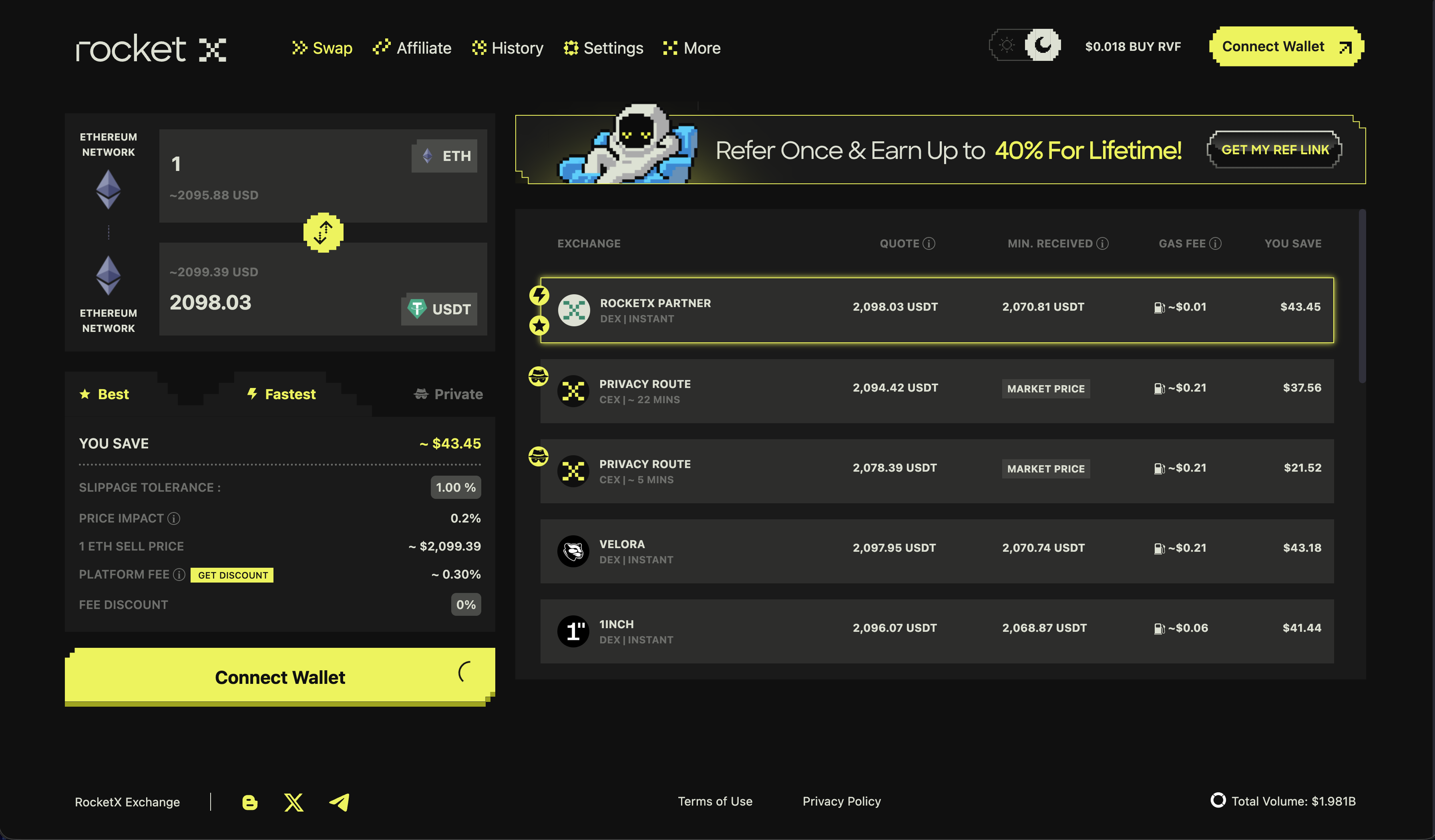
Rocketx may show estimated output, network fee expectations, slippage tolerance, receiving chain details, and wallet connection prompts. These details matter because cross-chain swaps are not just regular trades with a longer loading screen. A bridge can introduce settlement time, minimum or maximum trade sizes, route availability, and additional smart contract exposure. Rocketx users should read every preview carefully before confirming.
The protocol or interface behind any route may use liquidity from decentralized exchanges, bridge providers, market makers, or other routing systems. Rocketx is therefore part of a wider DeFi stack that includes wallets, token standards, smart contracts, wrapped assets, native gas tokens, and blockchain explorers. When something goes wrong, knowing which part of that stack is involved helps the user troubleshoot without guessing.
When would someone use Rocketx?
Rocketx is most useful when a person has funds on one chain but needs usable assets on another. A common example is holding SOL and needing ETH for activity on Ethereum, or holding a stablecoin on one network and wanting a token on a different network. Rocketx can also fit portfolio rebalancing workflows, chain migration, NFT preparation, DeFi participation, and wallet consolidation.
Rocketx may also appeal to users who want to compare bridge-style and swap-style paths in one place. For example, a user might need to understand whether they are receiving native ETH, wrapped ETH, a bridged representation, or another asset that only behaves similarly in certain contexts. That distinction matters for gas payments, marketplace purchases, lending markets, and later withdrawals.
In practice, Rocketx is not only about speed. It is about reducing the number of separate interfaces a user has to evaluate. Moving from one chain to another can otherwise mean opening a bridge, checking a DEX, confirming token contracts, looking at a block explorer, and then repeating steps if the route fails. Rocketx can make that journey more coherent, provided the user still verifies the final transaction details.
How to get started with Rocketx safely
Rocketx should be approached with the same care as any crypto wallet-connected application. Start by deciding exactly what you want to accomplish: the source asset, the source chain, the destination asset, the destination chain, and the amount. Rocketx can only be helpful if the user knows whether the goal is bridging, swapping, or both. Ambiguity is where expensive mistakes usually begin.
Rocketx workflows typically begin with a wallet connection, but users should avoid connecting a wallet full of unrelated long-term holdings if a smaller operational wallet is available. A dedicated wallet for swaps can reduce exposure. The next step is selecting the input token and output token, checking the route preview, confirming the recipient address, and making sure the destination chain is supported by the wallet.
- Confirm that the token contract and chain name match the asset you intend to trade.
- Check the estimated output, slippage setting, network fees, and any bridge fee.
- Make sure you have the correct native gas token on the sending chain.
- Review wallet approvals and avoid unlimited permissions when a smaller allowance is practical.
- Test unfamiliar routes with a small amount before moving a larger balance.
Rocketx can simplify the path, but it cannot remove the need to read the wallet confirmation. The wallet is where the binding approval happens. Before signing, users should inspect whether they are approving token spending, executing a swap, bridging an asset, or completing a second transaction. Rocketx may show a clean interface, while the wallet confirmation reveals the actual contract interaction.
Fees and costs of Rocketx
Rocketx users should think about cost as a combination of several items, not just a single quoted fee. A cross-chain swap may involve source-chain gas, destination-chain gas, liquidity provider spreads, bridge charges, protocol fees, price impact, and slippage. Rocketx may display some or all of these components depending on the route and the connected networks, but market conditions can change between preview and confirmation.
Rocketx can be attractive when it finds a route that avoids unnecessary steps, yet the cheapest-looking route is not always the best route. A path with a low visible fee may have weaker liquidity, slower settlement, or higher risk from a lesser-known bridge. A route with a slightly higher cost may be worth considering if it uses deeper liquidity or clearer settlement mechanics. This is not financial advice; it is a reminder to compare the full trade experience.
For smaller transfers, Rocketx users should be especially alert to fixed fees and gas costs. A bridge that is reasonable for a larger position may be inefficient for a small amount. Ethereum mainnet gas can be material during busy periods, while some layer 2 and alternative networks may be cheaper but still require the correct gas token. Rocketx can help estimate, but the final cost is determined by live network conditions.
Is Rocketx safe?
Rocketx safety depends on more than the brand name or the look of the interface. Cross-chain activity carries smart contract risk, bridge risk, liquidity risk, wallet approval risk, phishing risk, and user error risk. Rocketx may help organize the workflow, but users should still verify official domains, avoid sponsored impostor links, review approvals, and understand that blockchain transactions are generally irreversible once confirmed.
Rocketx users should also recognize the difference between permissionless access and practical decentralization. Some cross-chain systems rely on validator sets, liquidity providers, wrapped tokens, custodial or semi-custodial components, or external messaging infrastructure. Those designs can be useful, but they introduce assumptions. Rocketx can route through systems like these, so the safe choice is to understand the route rather than assume every cross-chain trade has the same trust model.
Rocketx is best used with conservative habits. Keep wallet software updated, use hardware wallets for larger balances when appropriate, bookmark official pages, reject unexpected signature requests, and revoke approvals that are no longer needed. When using Rocketx for a new token or route, confirm details through official project channels and a reputable block explorer. No guide can guarantee safety, and users should not risk funds they cannot afford to lose.
Rocketx compared with other swap and bridge options
Rocketx belongs to a broad group of tools that includes decentralized exchange aggregators, bridge aggregators, native cross-chain protocols, centralized exchanges, wallet-based swaps, and chain-specific bridges. The right option depends on the user’s priorities. Some users prefer a centralized exchange for simple BTC to ETH conversion. Others prefer a non-custodial route where they keep control of their wallet throughout the process. Rocketx is most relevant to the second group, especially when the trade spans multiple chains.
Rocketx differs from a single-chain DEX because it focuses on multi-chain intent. A DEX on Ethereum, Solana, or BNB Chain may be excellent for local liquidity but cannot always solve the full source-chain-to-destination-chain problem. Rocketx can reduce friction by combining route discovery and execution planning. The tradeoff is that a multi-chain route can involve more moving parts than a local swap.
Rocketx also differs from a centralized exchange because users generally interact through a wallet rather than depositing assets into an exchange account. That can reduce custodial exposure, but it also removes some support and reversal possibilities that users may expect from an account-based platform. With Rocketx, the user must be comfortable checking addresses, chains, fees, and transaction status directly.
| Option | Typical strength | Main caution |
|---|---|---|
| Rocketx | Combines swap and bridge routing across chains | Route risk and wallet approval review still matter |
| Single-chain DEX | Deep local token swaps on one network | Cannot always move assets to another chain |
| Centralized exchange | Simple account-based conversion for supported assets | Requires custody, account rules, and withdrawal support |
| Native bridge | Direct route for a specific ecosystem | May be limited to certain assets or chains |
What should users check before a Rocketx transaction?
Rocketx users should slow down at the preview stage. The most important checks are the sending token, receiving token, source chain, destination chain, recipient address, minimum received amount, and estimated completion time. Rocketx may make the route appear simple, but a single mistaken chain selection can leave the user with an asset they cannot use for the intended purpose.
Rocketx is especially sensitive to gas planning. If the destination chain requires a native token for future actions, receiving only a bridged asset may not be enough. For instance, a user preparing for an Ethereum NFT purchase needs usable ETH for gas, not just a token with similar market value. Rocketx can help move assets, but the user must confirm that the output asset solves the actual task.
Before a larger transaction, Rocketx users should consider doing a small test transaction, checking explorer status, and waiting for completion before repeating the route. That adds time, but it can reveal wallet compatibility issues, bridge delays, or asset support problems. Rocketx can be efficient, yet careful sequencing often matters more than saving a few minutes.

Rocketx for practical multi-chain workflows
Rocketx becomes more useful as a user’s crypto activity spreads across networks. Someone who only holds assets on one exchange may not need it often. Someone who uses DeFi, NFTs, staking, gaming, layer 2 apps, and multiple wallets may regularly face the question of how to move value from one chain context to another. Rocketx addresses that practical problem.
Rocketx can support a cleaner workflow for users who think in terms of outcomes: get ETH on a target chain, move a stablecoin to a lower-fee network, rebalance between major assets, or reach a token market without several manual bridges. Internal planning pages such as and can help users separate simple swaps from full cross-chain transfers before they connect a wallet.
Rocketx is not a substitute for learning basic crypto mechanics. Users should still understand seed phrase security, wallet networks, token approvals, contract addresses, wrapped assets, slippage, liquidity, and block confirmations. The better a user understands those ideas, the more effectively they can evaluate any route Rocketx displays. A good interface can reduce confusion, but it should not replace independent verification.
How to think about Rocketx before using it
Rocketx is most valuable when treated as a route-finding and execution aid, not as an autopilot. Cross-chain crypto is powerful because it lets users reach many ecosystems, but that same openness creates room for confusing assets, fake tokens, unsupported routes, and changing liquidity. Rocketx can make multi-chain movement more approachable, yet the user should remain deliberate at every step.
Rocketx may be a strong fit for people who already understand wallet-based trading and want a more direct way to compare cross-chain paths. It may be less suitable for someone who is brand new to crypto and has not yet learned how gas, approvals, and irreversible transactions work. Starting small, verifying official sources, and keeping records of transaction hashes are sensible habits for any Rocketx workflow.
Rocketx ultimately reflects the direction of DeFi: users want assets to move across networks with less friction, while still keeping control of their wallets. That goal is useful, but it comes with technical and financial risk. Before using Rocketx, compare routes, read the transaction details, check current official information, and make decisions based on your own risk tolerance rather than promotional claims or price speculation.
Questions and Answers
What is Rocketx used for in crypto?
Rocketx is used to help plan and execute crypto swaps and bridge-style transfers across different blockchains. A user may use Rocketx when funds are on one network but the desired asset or application is on another. It can help compare routes, estimate output, and reduce manual steps, but users still need to verify chains, tokens, fees, and wallet confirmations.
Is Rocketx the same as a regular decentralized exchange?
Rocketx is not exactly the same as a single-chain decentralized exchange. A regular DEX usually swaps tokens within one blockchain ecosystem, while Rocketx focuses on multi-chain routing that may include both a swap and a bridge step. That broader workflow can be convenient, but it may also introduce additional bridge, liquidity, and smart contract risks.
What fees should I check before using Rocketx?
Before using Rocketx, check source-chain gas, destination-chain needs, bridge fees, protocol fees, liquidity spreads, price impact, and slippage settings. The displayed estimate may change as network conditions and liquidity shift. For smaller transfers, fixed fees and mainnet gas can consume a large portion of the trade, so comparing routes carefully is important.
Is Rocketx safe for cross-chain swaps?
Rocketx can make cross-chain swaps easier to review, but no crypto bridge or swap route is completely risk-free. Users should verify the official site, inspect wallet approvals, confirm token contracts, use small test transfers for unfamiliar routes, and understand that blockchain transactions are generally irreversible. Safety also depends on the route providers and smart contracts involved.
Do I need gas tokens to use Rocketx?
Yes, users typically need the native gas token for the sending chain, and they may also need gas on the receiving chain for later actions. For example, receiving a token on Ethereum or a layer 2 may not help if you have no ETH available for future transactions. Rocketx users should plan gas before starting a swap or bridge.
Can Rocketx swap assets between Bitcoin and Ethereum?
Rocketx may be relevant to users researching routes between Bitcoin-related assets and Ethereum-based assets, but availability depends on current supported routes, liquidity, and the specific form of the asset. Some routes use native cross-chain systems, while others rely on wrapped assets or bridge infrastructure. Always verify current support and understand what asset you will receive.
How should a beginner approach Rocketx?
A beginner should approach Rocketx slowly, starting with a small test transaction and a clear goal. Choose the source asset, destination asset, source chain, and destination chain before connecting a wallet. Review every estimate and wallet prompt, avoid rushing approvals, and confirm details through official sources. Rocketx can simplify routing, but it does not remove user responsibility.